
AI-Ready On-Page Structure for Service Businesses
We structure your website so that Google, Bing and AI systems classify the content reliably — and people quickly understand whether your offer is a good fit.

Why now
- Search behavior is shifting: people don’t search only via Google/Bing, but also via AI systems.
- AI needs unambiguous signals: services, terminology and page logic must be clear and consistent.
- Usability counts twice: what people understand quickly is also easier to parse machine-readably.
What you get
- Page blueprint: home, services, service subpages, about, references/examples, contact.
- Keyword and intent logic: one main topic per page, clear search purpose, no mixing.
- Content structure: H1/H2/H3, text blocks, snippets, clear paragraphs, user-oriented sequence.
- Internal linking: meaningful paths (home → service → detail → contact) with context.
- AI standards: about snippet, FAQ with real questions, clean semantics + FAQPage JSON-LD.
- Technical basics: image strategy, load-time checkpoints, minimal scripts, clean HTML.

How we work
1) Analysis
Current state, page hierarchy, search intents, weaknesses in structure and content logic.
2) Blueprint
Information architecture, page roles, internal links, priorities — as a clear plan.
3) Implementation
Concrete content and structure guidelines plus technical baseline checks so it goes live cleanly.
Who this is for
- Trades, construction, technology (e.g., plumbing, electrical, interior finishing)
- Beauty & health (e.g., hairdresser, studio, practice, therapy)
- Architecture, planning, consulting (e.g., architects, engineers, experts)
- Local providers with multiple services currently “thrown together” on one page
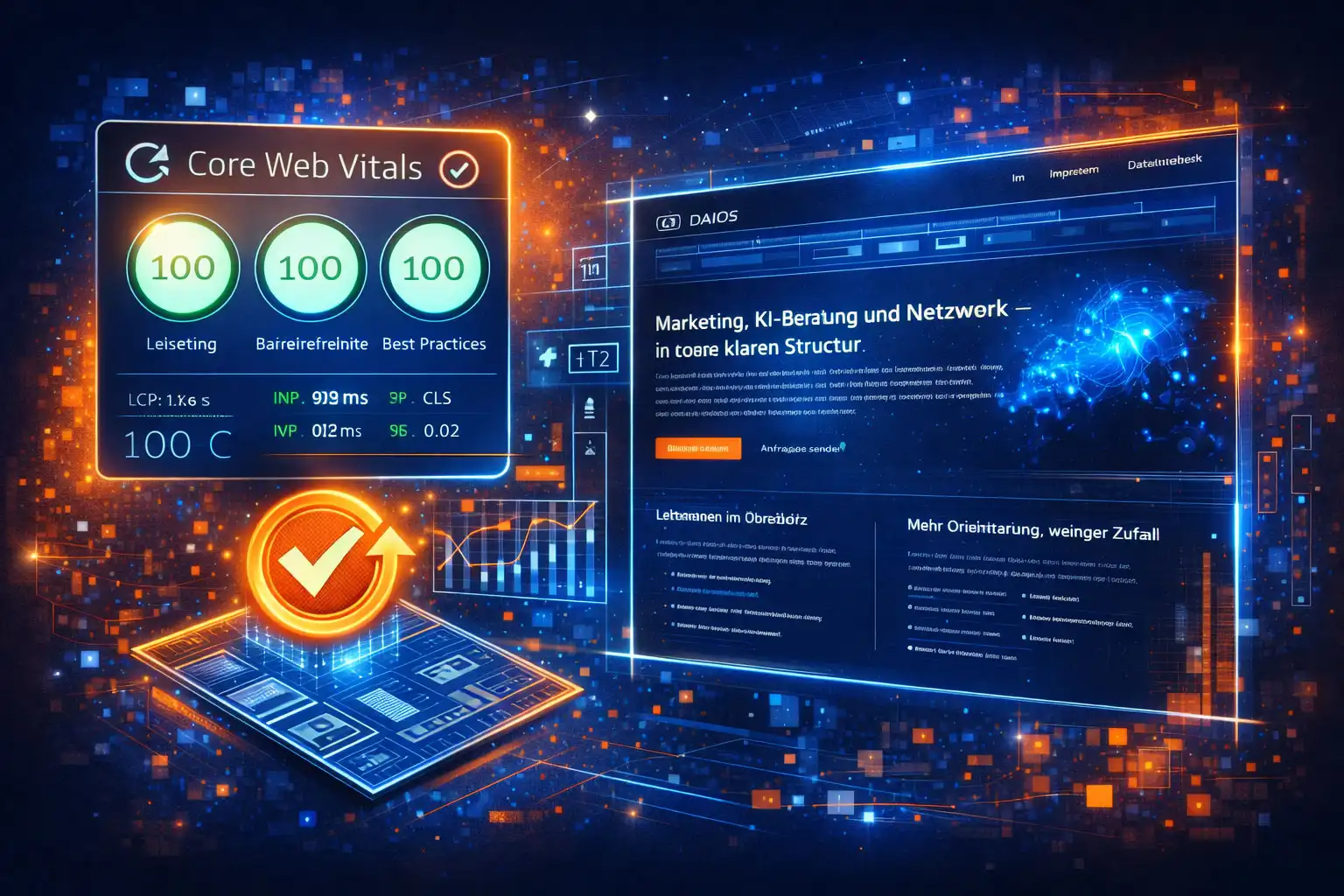
Typical effects
More clarity
Users understand faster: what do you do, for whom, and how does it work?
Better classification
Search engines and AI models can categorize services cleanly.
A more stable foundation
Structure works long-term — independent of short-term tactics.